
E-Collar Training
E-Collar Brands We Trust
What Is an E-Collar?
When we refer to an e-collar, we’re talking specifically about a remote electronic training collar: the dog wears a receiver and the handler carries a remote.
Depending on the collar, the handler may have access to stimulation, vibration, tone, or a combination of these.
The goal isn’t simply to press a button when the dog does something wrong.
Through proper conditioning, the dog learns what the sensation means and what behavior turns that pressure off. At the same time, we continue using our voice, leash, food, toys, praise, and other rewards.
Eventually, the e-collar can become another form of communication—almost like having a very long invisible leash.
Quality Matters
A $50 or $60 electronic collar and a professional-quality e-collar may advertise many of the same features. That doesn’t mean they operate the same way.
One of the most important differences is consistency and adjustability of stimulation.
We want small, predictable changes between levels so we can find the lowest effective level for the individual dog and situation. A poorly designed collar may provide little noticeable sensation at several settings and then make a much larger jump. That’s not the precision we’re looking for.
Fit matters too. The contact points need consistent contact with the dog’s skin. A loose receiver can produce inconsistent communication and tempt someone to unnecessarily increase the level when the real problem is simply poor contact.
Reliable equipment and proper fit are part of responsible e-collar training.
The E-Collar Is a Communication Tool — Not a Shortcut

Few dog-training tools create as much debate as the electronic collar.
Some people view an e-collar as inherently harsh. Others put one on a dog, press a button, and expect it to solve problems.
We don’t agree with either the theory or the approach.
An e-collar is a tool. How it is introduced, how it is used, and whether the dog understands what the sensation means are what matter.
Used properly, an e-collar can create another clear line of communication between you and your dog. Used improperly, it can create confusion, anxiety, and unnecessary discomfort.
That’s why we don’t start with the button.
We start by teaching the dog.
Conditioning Comes Before Correction

This may be the most important part of e-collar training.
We don’t want the dog thinking that a strange sensation is happening for no apparent reason.
Before relying on an e-collar for any reason, the dog should understand the behavior we’re asking for and be taught what the collar sensation means (in most cases).
Early conditioning is generally done with the leash and e-collar on simultaneously. Done properly, this helps prevent the dog from becoming confused about what the e-collar sensation means.
For example, if we’re teaching recall, the dog learns that our recall command and the e-collar sensation mean: Come back to me.
When the dog responds correctly, the pressure goes away and we can reinforce that decision with food, praise, play, or another reward the dog values.
The dog isn’t guessing. We’re building a language.
There Is No Magic Number
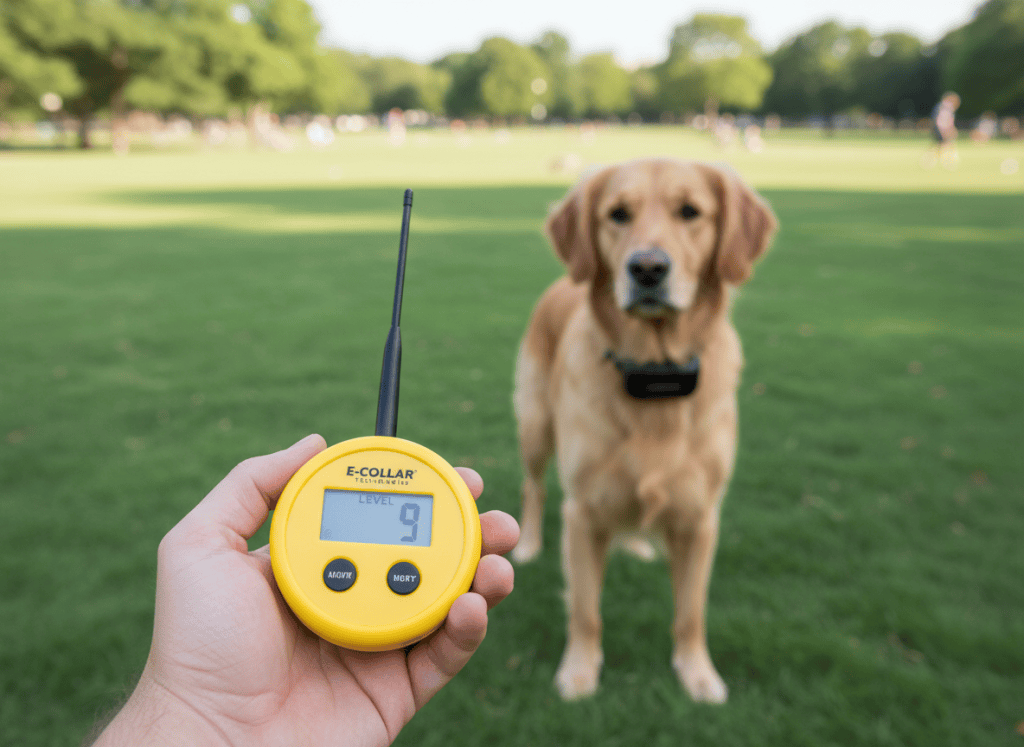
Dogs don’t read the numbers on the remote.
A level that one dog barely notices may be significant to another dog. And the same dog may respond differently depending on what’s happening around them.
A dog relaxing in the living room is in a completely different state of mind than that same dog chasing a squirrel, reacting to another dog, or running toward something exciting.
That’s why we don’t believe in arbitrary rules such as: “Never go above this number.”
The question isn’t simply what number is displayed on the remote.
What does this individual dog feel? What is happening in the environment? What level of distraction are we dealing with? And does the dog understand what we’re asking?
Why Use One If We Already Have a Leash?

Sometimes a leash, food, toys, praise, and your voice are all you need. When they are, that’s what we should use.
But distance changes things.
Your dog may be hiking, running, exploring, or simply far enough away that physical leash communication isn’t available. Distractions can also become strong enough that something which works perfectly in the house suddenly means very little outside.
A properly conditioned e-collar allows us to communicate with the dog at a distance.
That can be particularly valuable for recall and off-leash reliability, because the communication doesn’t disappear simply because the leash is no longer attached.
Correcting Unwanted Behavior

Not every unwanted behavior can simply be ignored or redirected forever.
Once a dog clearly understands what is expected, an e-collar can also be used to interrupt or correct unwanted behavior.
But there’s an enormous difference between correcting a dog that understands the system and simply putting an e-collar on a dog and pressing a button whenever we don’t like something.
Poorly timed corrections can create unintended associations.
For example, correcting a dog that is already highly reactive toward another dog without proper foundation work can potentially make the situation worse. The dog may associate the uncomfortable sensation with the other dog rather than with its own behavior.
That’s exactly the kind of confusion responsible training is designed to prevent.
The tool should make communication clearer—not more confusing.
Finding the Stimulation Sweet Spot Creates Better Training

Our goal isn’t to find out how much stimulation a dog can tolerate.
It’s to determine what level of communication is appropriate for that dog in that situation.
Too much pressure can cause unnecessary discomfort or distress.
Too little pressure during intense arousal may accomplish nothing—or simply add another irritation to an already frustrated dog.
Good e-collar training isn’t about automatically going high or staying artificially low.
It’s about reading the dog and using the tool thoughtfully.
An E-Collar Doesn’t Replace Rewards

If your entire training experience consists of your dog trying to avoid corrections, put bluntly, you’re not being fair or kind to your dog.
Food, toys, praise, play, freedom, and engagement remain extremely important.
We use the e-collar to communicate while continuing to reward good decisions.
That gives the dog two pieces of information: Here’s what I need you to do. And: Good things can happen when you do it.
That’s a much more complete training system than relying exclusively on either rewards or corrections.
Not Every Dog Needs an E-Collar

Not every dog needs an e-collar.
Whether an e-collar makes sense for your dog has a lot to do with your dog, your goals, and the lifestyle you want to share together.
For some families, a six- or eight-foot leash provides all the freedom their dog needs. For others, they want to hike, explore, spend time in appropriate open spaces, or simply allow their dog considerably more freedom while maintaining a reliable way to communicate at a distance.
That’s where we believe a properly conditioned e-collar can be an amazing tool.
When it’s introduced correctly and used responsibly, it can help give many dogs substantially more freedom—not less.
It can allow you and your dog to enjoy walks, hikes, training, exploring, and experiences together that may have been difficult or unrealistic before. It can also give you added confidence that when life happens and your dog becomes highly stimulated or excited, you have another tool to help regain their attention, communicate clearly, and bring them back to you. In many situations, that additional line of communication can make all the difference.
And that’s ultimately how we look at the e-collar.
The goal isn’t to make your dog dependent on a piece of equipment. The goal is to build communication, reliability, and trust that can open up more of the world for you and your dog to enjoy together.

